Wednesday, June 29, 2011

Yosemite: In Praise of Danger


I’m not usually afraid of heights. Normally, I relish the view from an exposed cliff. I’ve climbed 280-foot Douglas-fir trees and swayed in the breeze.

But this Saturday, standing 3,500 feet above Yosemite Valley at Taft Point, I found myself a little bit nervous. Actually, it was just about the scariest place I’ve ever been.


No ranger reminded me to step back from the edge. No fence defined a safety zone along the cliff. For the first few minutes, I had the place entirely to myself – just me, a raven, El Capitan, Yosemite Falls, and one of the most amazing drop-offs in the world. A bit shaky, I stepped up to the one short span of railing and tested its solidity. When the next hiker appeared, she did the same.


Earlier that day, I’d stood surprisingly unmoved with a whole crowd of others at Glacier Point, each of us taking identical pictures of Half Dome. It wasn’t until I walked up Sentinel Dome that I really enjoyed the place. Apparently, I need to hike to a view to properly appreciate it.

To reach Taft Point, we hikers had floundered through snowfields and downed trees, comparing notes along the way: “Is that a trail over there?” Yosemite has had 178% of normal snowpack this year; many of the routes at 8,000 feet are still buried under dirty snow, pocked with pine needles and mud. Only the adventurous – from babies to grandmothers – make it to the cliffs and fissures of Taft Point.


Someone once asked why I value bringing young people to the wilderness. Besides the obvious – it’s beautiful, it’s educational – I keep coming back to one answer: “The dangers are real.”

I’ve driven students to Six Flags (with its fake sequoia trees), where they’re happy to spin upside down above the crowds below. When the same students visit the real Sequoia National Park, they’re just as fearless: they’ll jump to a rock in the middle of a swirling torrent (drowning is Sequoia’s number one cause of death), or climb over the railings on a fogged-in Moro Rock, unconvinced of invisible drop-offs. They have guts – useful on roller coasters – but no sense of real danger.

Recently, I went to Disneyland with my younger daughter and her girlfriend. Despite my doubts – too many people, nothing “real” – it was fun. I enjoyed the curves on Thunder Mountain (far milder than the rides at Six Flags) and drenched my clothes on that terrifying fifty-foot Splash Mountain plunge: if millions have survived it (I told myself), it must be safe. This was at midnight, our final ride; afterwards, we dripped our way back to the motel, laughing the whole time.


The difference between that safety-inspected thrill and a national park is extreme. On the whole, most people do survive parks – they recognize the risks and remain cautious. Children who grow up with real dangers learn to move carefully, to pay attention to their surroundings. They learn responsibility for their own safety. Those who’ve been protected from all but “safe” thrills may not recognize real danger; convinced they’re invincible, they take foolish risks.

When I first approached Taft Point, its one small railing seemed intrusive. But this railing, unlike the wall at Glacier Point, is different. Instead of catching careless tourists, it reassures shaky hikers, allowing them to approach the edge and peer into the abyss – and then to explore the rest of the unguarded cliff top, pondering nature in all its breath-taking dangerousness.

It’s a danger that’s worth respecting. And long may that danger remain.


Friday, May 13, 2011

The Economy Hits Home: Takeaway Café Closes its Doors

For a while I thought the disasters had eased. Last month the government didn’t close. Apart from some major tornadoes and record river floods, the natural world seemed almost to have forgotten us.

And then I found that Takeaway Café had closed.

Even the sign is gone. All that remains is a small typed message on the door: “We must regretfully close our doors due to economic conditions.”

It was my closest place of business, my corner shop – at least, my corner-of-the-mall shop. It was the place where I could chat with the proprietors and eat a packet of Kettle Chips while waiting for a Kilkenny salad. It was the place where I bought breakfast casserole or spinach quiche for visitors, lasagna for book group, beef stew for a birthday party.

So where will I find a “home-cooked” meal? Where will I get the extra bacon bits for my weekend omelet?

It’s not that I can’t cook. I can, but living alone, I usually lack both inspiration and time. When I do suffer a fit of good intentions, my fridge fills up with moldy peppers and lettuce.

I suppose I should have seen it coming. Things aren’t going well around here. In the next block over, three of seven houses are empty, their lawns overgrown, torn curtains or blinds in the windows. (How is it that empty houses always have ragged drapes?) The news suggests that things will only get worse.

If an excellent local business like Takeaway Café can’t make it, who can? I only wish I’d known to fill my freezer before they closed.

Sunday, May 8, 2011

Happy Mother’s Day: Publishing My Mom’s Haiku Book

I sometimes joke that to earn enough to retire, I’ll have to work till I’m 84. It may be possible… at 84, my own mother teaches “Write Your Life” at her community college, sits on the board for an adult day care center, and participates in at least four reading or writing groups.

She also shares her Haiku at poetry readings, and for years her friends have begged her to publish a collection. So about a year and a half ago, my sister and I helped her create a book.

My mom chose 160 of her favorite Haiku poems. Mary and I searched our computer files for pictures to complement them, pictures that would look good in black and white – no delicate fall colors or bright reds on greens. Our brother Tom and Mary’s son also contributed photos.

Ten days before Christmas, as soon as her grades were in, Mary started playing with layouts. She emailed me each new draft, and in between creating exams and grading papers, I proofed poems and suggested formatting changes. Within a week, we had a book.

If this were a traditional story, we might have sent the manuscript to a publisher, waited months for a response, and given up after a few rejections. But as my mother said, “I don’t have time to wait.” We chose to self-publish instead.

Poets have a long history of self-publishing. In this case, we took it a step further, with photographs and a professional binding – not to mention an ISBN number. Within days, we had the first copy in hand.

Writers have a disadvantage when it comes to recognition. Artists sell directly to their customers – a painting sold can feel like instant success. Writers can’t sell stories in the same way. To sell our work in a local bookstore, we first need to please a publisher in New York.

In this case, self-publishing was the way to go. We’re happy with the way the book turned out, and so is my mother.

Readers have commented on how well our photos fit the poems. I found it surprisingly easy to find the right ones. A Haiku poem, like a photograph, captures a moment in time, and at its best, it reflects on that moment. Often, we’re “seeing” in the same ways.

Once the book was out, my brother created a website for it. You can see sample pages or buy the book ($14.95) from Tom’s site or through Lulu.com.


My Spirit Sings
– Haiku by Betty McCauley
http://www.bettymccauley.com/


I’m glad we’ve been able to create this “legacy” while my mom is still around to enjoy it. And I hope I’m still as active at 84 as she is. Happy Mother’s Day!


Friday, May 6, 2011

Camping Alone: Spring Break at Joshua Tree


For weeks I’d dreamed of the desert. I’d drift off over a stack of grading, and the images would appear out of nowhere: red cactus, green Joshua Trees, golden rocks.

Spring Break came late this year, tied to a late-April Easter. I started for Joshua Tree on Sunday afternoon, the car full of grading and gear, and drove straight east into an orange moon that rose like a bridge over the highway ahead. I set up my tent by moonlight and spent a lazy morning in camp.

Later I drove up to Hidden Valley, remembering previous trips. The first was in 1980, when Rhiannon was a baby. In March of 1994, longing to be somewhere completely different – somewhere far from Douglas-fir trees – I put both girls in the van and drove south from Oregon, putting 2,800 miles on the car. We all climbed on the rocks.

Most memorably, I sought refuge at Joshua Tree when I learned – the morning after leaving Emily at her expensive LA college – that my editing job was ending. I trudged the Hidden Valley trail in the August heat, sand in my Birkenstocks, pondering the future. In fact, that loss pushed me to teach more classes, which eventually led to a full-time job – much closer to J-Tree, as Rhiannon and the other climbers call it. Now I could join them.


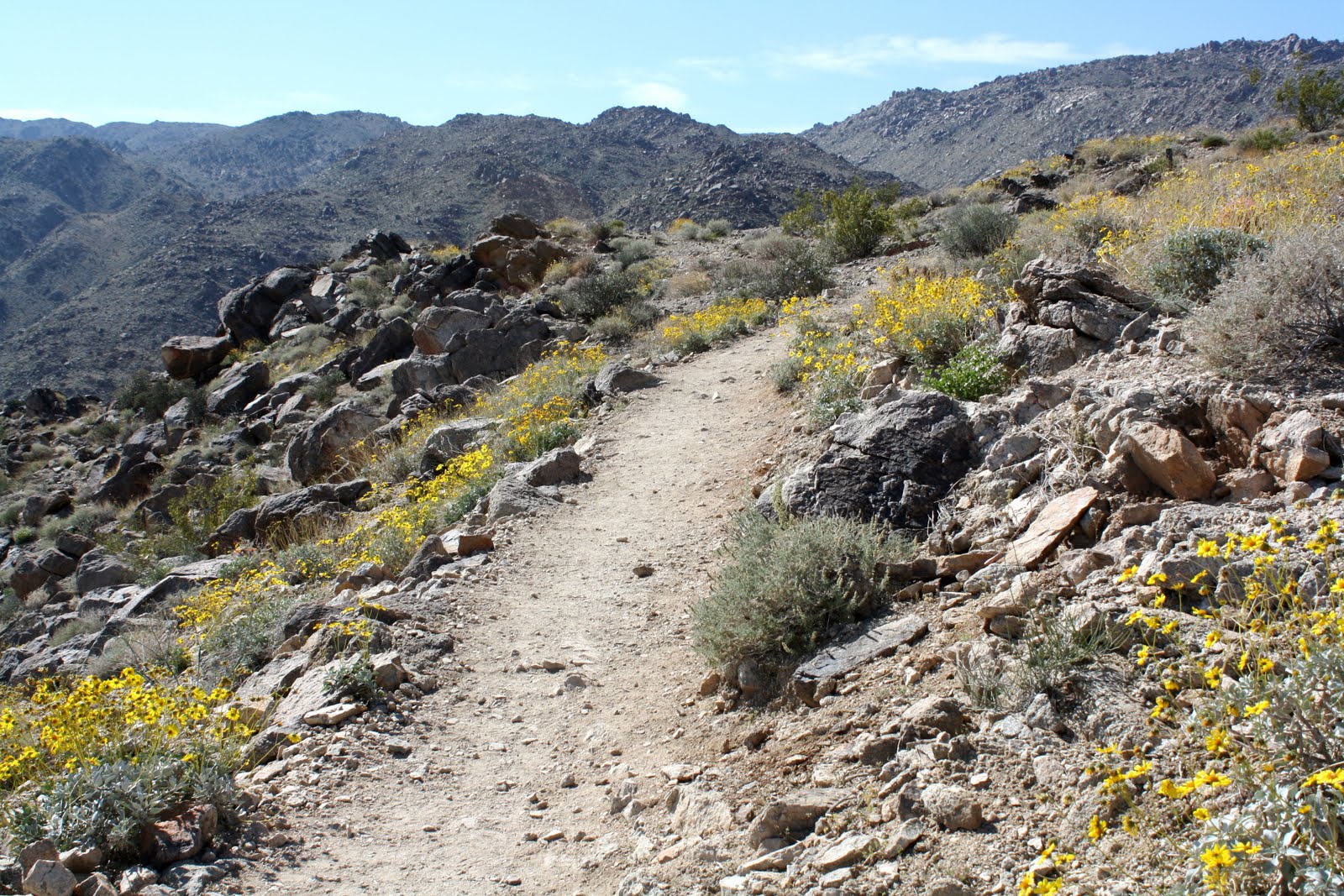
This time I knew to wear boots. I also knew where to find the first glimpse of a bright red Mojave mound cactus. Climbing a rock, I saw a distant barrel cactus with yellow flowers. But the sky was hazing over; the rocks seemed dull in the mid-day light.


By the second day, I’d figured out the rhythm. Up with the sun, and a morning of exploration while it was cool and the light was crisp. Then, as the sky bleached out and the rocks lost their texture, an afternoon of grading. Finally, more exploring as the boulders regained their golden evening glow. Or that was the theory.


In fact, the morning’s adventures tended to last till mid-afternoon, and the grading… well, yes, the grading. It’s always the same on these trips – I bring great intentions and a big stack of papers, and somehow it’s always too hot, too cold, too windy, too bright, too dark… and the same essays come back to town, unread. Maybe I should just cut the outings short and grade at home.


But this time I did fairly well. I actually worked during the afternoons, reminding myself that flat light means boring pictures. I sat at a shaded table at Cottonwood Springs, or in my own camp, or at a picnic area where foreign tourists scrambled up rocks. And I did finish one stack of essays. So that was progress, sort of.


More important were the hikes. I found cactus blooming – six kinds – and purple verbena and bright red paintbrush. I climbed Ryan Mountain and repeated the 49 Palms trail, lined with barrel cactus and chuckwalla lizards – a trail I’d once hiked with my friend Mary. This time, a talk with hikers on that trail led to a musical campfire evening. (Go where you want to go, and you’ll meet the people you want to meet.)


Sitting by my own fire on the last night, I thought about my first solo camping trip – three and a half weeks across the west in 2004. (See today’s other Blog entry.)


I haven’t done another trip that long, but since moving to California, it’s become a tradition to visit the desert over Spring Break: Death Valley, Organ Pipe in Arizona, Joshua Tree. Deserts have the earliest spring flowers, and I like camping where it’s warm. Camping alone in a wet Oregon forest just wouldn’t be the same.


Alone? “Aren’t you scared?” “Don’t you get bored?” No… it’s not scary, and I never run out of things to do. I do try to camp surrounded by friendly families. If I called for help, someone would hear me. But so far, I’ve never needed to shout.


National Park campgrounds are the best. At J-Tree’s Indian Cove, each camp backs onto its own slab of granite. The skyline fills with tiny people exploring giant boulders, as my own girls once did.

That last evening, I sat by my fire, alone but surrounded by humanity, and typed on my laptop. Nearby, the couple beyond my boulder sat by their own fire, flames lighting the rock behind them. Further away, someone beat a monotonous rhythm on a drum. At the group camp down the valley, cheers and shouts erupted at regular intervals.

I wanted to stay forever. Why go back? I had the wilderness, plus all the technology I needed: a laptop that usually worked, a good camera, a reliable Subaru full of rechargers….

But I knew it was time to deal with the rest of the semester. Still, I’m already thinking about the next trip. It’s nearly summer….


Camping Alone: The First Solo Trip, 2004 – A Journey Through Rocks

Sitting alone by the campfire at Joshua Tree this spring, I found myself remembering my first solo car camping trip.

It was 2004, and I had no money. But I did have a few weeks between summer and fall terms, and all spring I’d been thinking about joining Rhiannon in the Rockies – how else could we do the annual backpacking?


In late August, I set out in my old blue Subaru, heading east across Oregon. I was nervous, though not about being alone. I was worried the car would break down before I was out of the state, dashing the dream I’d nurtured all year: just get in the car, alone, and drive… It was hard to believe the trip could actually happen.

Late that evening I stopped at Ochoco Divide, a familiar campground – just far enough from home (about three hours) that it felt like progress. In the morning, I spread my badly organized gear across the table to sort: these things to use, those to put away for later. (And of course this reminded me of our first trip across the Sahara, in an ancient Land Rover so full of spare parts that the extra weight itself led to additional break-downs.)

That afternoon, heading toward Idaho, I found myself beginning to relax: if I could make it beyond the Oregon border, maybe nothing would stop me.

I did make it beyond the Snake River. I camped across Idaho – at a sand dunes park, and the City of Rocks – and then at several places in Utah and Colorado. Thinking ahead to the Rockies, I looked for the highest hike at each camp: the top of the Bruneau Dune, up to Delicate Arch at Arches, a breathless walk to a viewpoint at that first 10,600-foot pass on Colorado’s Interstate 70. (I wasn’t expecting that one – neither was my car.)


During our three days of backpacking at Rocky Mountain, we reached 12,420 feet – the highest I’d ever hiked, before or since. After a day huddled under the tarp in snow and rain, we arose to blue skies. At the top of Tanima Pass, we found roseroot sedum blooming in the snow.


When I started that road trip, I feared I might be bored. How would I spend my evenings? What would I think about during those long days of driving? I packed maps and travel guides and notebooks and books on tape.

But in the end, the problem was lack of time, not lack of things to do with it. By the time I’d found a campsite, put up my tent, and heated a meal, there was hardly time to scrawl a few notes before crawling into my sleeping bag. The notes are still in that notebook, barely legible; I dreamed of one day having a laptop and a way to charge it. When picture cards filled, I had to beg Rhiannon’s colleague or my nephew in Santa Fe to download the photos onto a CD.


I found I liked traveling alone – I liked it very much indeed. I learned all the tricks of living on the cheap. Gas cost less then, and along with the canned soups and mashed potato packets in my car, the cheapest meals were the Polish dogs or burritos at the gas station mini-marts. Sometimes I’d heat a kettle on the camp stove and wash my hair.

By the time I’d driven west through New Mexico and Arizona, I was ready to travel forever. “A Journey Through Rocks,” I called the trip later, sorting my pictures; everywhere, there were arches and passageways and gaps in the rocks – not to mention the ancient houses in built into the cliffs at Mesa Verde.

One of the last stops was at Santa Monica Beach, where I was joined by Emily and my brother – it seemed that everyone ended up in California. (It was just a year later that I drove my 26-foot U-Haul to the Central Valley, followed by Emily in the blue Subaru.)

Driving the long straight miles up Interstate 5, I finally resorted to entertaining myself with story tapes. School would start within days. I’d been on the road for three and a half weeks, but I didn’t want it to end. I’d found it was possible to travel alone – possible, and very enjoyable. And I’ve been doing it ever since.


Saturday, April 9, 2011

If a Tree Grows in the Wilderness....

For months, it’s been one thing after another: Middle East turmoil, Japanese disasters, national budget crises, statewide financial struggles – even at my own college, classes have been cut and advertised positions canceled. Every time I open my laptop, there’s something new.

So yesterday, when a government shutdown seemed imminent, I did what I always do during bad times – I went to the mountains. Despite April flowers in the valley, snow covered the hills, which were shrouded in cloud. Sunshine was predicted for the weekend, but by then the national parks might be closed.


Up in the foothills, redbuds bloomed bubble-gum pink amidst the greens, just below the snowline. In the Giant Forest, snow banks towered above my car. At Round Meadow, the path was a series of faint indentations, buried under eight inches of light new powder. I swished through on snowshoes, breaking trail.

I didn’t go far. I stopped along the edge of the meadow, where giant sequoia trunks glowed faintly red beyond the snow. A tentative patch of blue sky suggested sunshine. I stared at the trees and thought about disasters.

If a tree grows in the wilderness and no one can visit it, does it really exist?

For a moment, the sun lit up the trees across the meadow – then it faded. I followed my own tracks back to the road and trudged up the hill. At the main parking lot, the Beetle Rock trail was also pristine, the most recent footprints hidden under snow.


Beyond the rock, clouds hung over the valley, shafts of sun lighting distant rainstorms. I waited for a long time until the sun emerged below the cloud bank. For a moment, the snow sparkled; my shadow appeared on the next ridge east. Then it faded, and the sun went back into the clouds.

I drove down the curves in the dark. Just before I came down out of the snow, a black bear scrambled up out of my headlights into the trees – first bear of the season.


Eventually, I learned the shutdown had been averted. One crisis avoided, at least for now. But the rest are still hanging over us.


Saturday, October 9, 2010

Connecting on Castro Street

I live in the heart of conservatism, California’s south Central Valley. It’s my neighbors here who voted to protect marriage by denying that same right to gays. It makes for a challenging place to teach, and most of us keep our political views to ourselves, at least in the classroom.

Nevertheless, when a Rutgers student committed suicide after his roommate aired video of him “making out with a dude,” a small flurry of messages – well, at least four – hit our all-campus email.

Uncharacteristically, I joined in:

Some people may protest that the students at Rutgers were only playing a prank – they didn’t really hate the student involved. But actions have consequences, no matter what the intention. And that’s the angle I plan to take when I talk about this issue in class. . . . this isn’t a matter of politics – it’s a matter of basic decency and civility. I hope a discussion will help our students realize that words and actions have power, sometimes even more than intended.

Having thus committed myself, I had to follow through. I shared the Rutgers student article in every class. On the whole, even those students who “disagree with that lifestyle” were appalled by the roommate’s actions. I also mentioned the “Safe Zone” sticker on my door. It shouldn’t be necessary to label myself as “safe” – comfortable with gay concerns – but apparently it is.

Yesterday, I visited San Francisco with a group of students. Some had never been to this city before, never ridden a train, never bought a ticket for the subway – and perhaps never knowingly met someone who was gay.

Toward the end of the day, we all rode the trolley up Market Street to the Castro District. It was a lovely blue-skied day, with rainbow flags catching the sun. We saw a few presumably gay couples, a poster for drag queen shows, a shop with videos featuring two men, and a number of random tourists. Pretty tame stuff, really.

Nevertheless, our students found it intense. They were a bit uncomfortable – as shown by the nervous giggles – but still fascinated. The high point was apparently the guy in high heels with the purple wig. “I like your hair,” someone told him, meaning it.

As we descended into the station at Harvey Milk Square, I mentioned that I’d almost watched the opening of “Milk” at the Castro Theater. “That would have been so awesome!” one student exclaimed. “I loved that film!”

So, now and then, I see a glimmer of hope. Even the language suggests possibilities: the phrase “gay marriage” would have seemed unthinkable a few years ago. If language can change, maybe attitudes will follow.

Last week, when we talked about the Rutgers suicide in one class, the only anti-gay comments came from two thirty-something students. Many of the eighteen-year-olds claimed to have gay cousins or friends; most seemed at least somewhat accepting.

I think the change will come, but it feels slow. After all, it’s bullying by other teens that seems to have led to the current rash of gay student suicides.

Maybe it’s a mistake to keep our views to ourselves. I still think my teaching is most effective when I avoid pushing my own beliefs. But opening students’ eyes is another matter. And when it comes to basic civility and decency, we definitely need to take a stand.